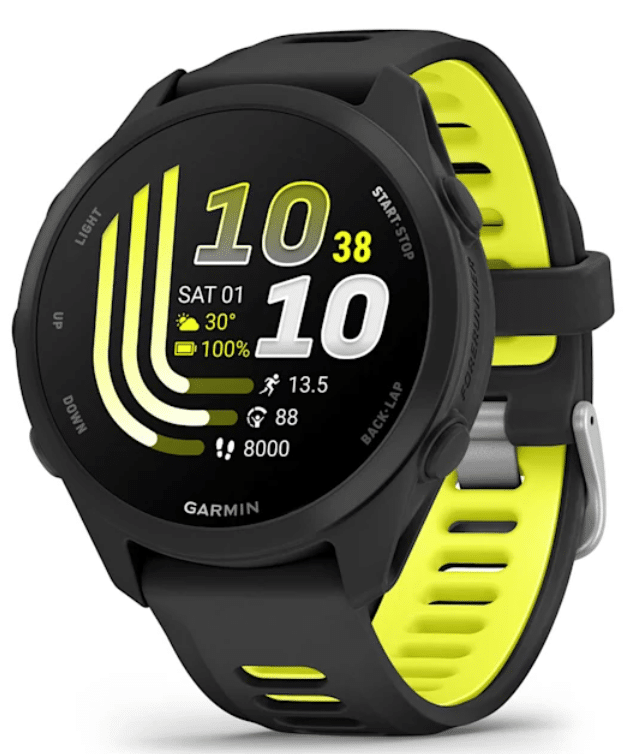
Garmin’s Forerunner line has long been the go-to choice for serious runners who want accurate GPS, smart health tracking, and an ecosystem that actually helps them improve. The Forerunner 165 launched in early 2024 and quickly became one of Garmin’s most loved budget AMOLED running watches. In May 2026, Garmin officially unveiled its successor — the Forerunner 170 — at $299.99.
If you already own a Forerunner 165 and are wondering whether to upgrade, or if you’re shopping for the first time and deciding between the two, this side-by-side breakdown covers everything you need to know.
The Forerunner 170 was launched together with Forerunner 70, check our comparison of Differences between the two watches.
Design and Dimensions
Both watches share a remarkably similar look and feel. The Forerunner 170 carries forward the same 42–43 mm fiber-reinforced polymer case and five-button layout, making the transition from the 165 feel entirely natural.


The displays are identical at 1.2 inches with 390 × 390 resolution, and both use Garmin’s 20 mm quick-release band system. The key visual upgrade on the 170 is a slimmer bezel, giving it a slightly more modern, premium appearance.
| Feature | Forerunner 165 | Forerunner 170 |
|---|---|---|
| Case Size | 42.6 mm | 42.6 mm |
| Display | 1.2″ AMOLED, 390×390 | 1.2″ AMOLED, 390×390 |
| Controls | Touchscreen + 5 buttons | Touchscreen + 5 buttons |
| Band System | 20 mm quick-release | 20 mm quick-release |
| Bezel Style | Standard bezels | Slimmer, more modern bezels |
| Water Resistance | 50 meters | 50 meters |
Verdict: Nearly identical in design. The 170 looks slightly more polished, but if you like the 165’s look, you’ll feel right at home with the 170.
Health Tracking Features
The Forerunner 165 covers the everyday health essentials well — heart rate monitoring, SpO₂, sleep tracking with nap detection, HRV Status, Body Battery, stress tracking, and menstrual health logging. The 170 keeps all of that and builds on top of it with Garmin’s latest software stack.
New health features on the Forerunner 170 include:
- Sleep Coach with nap detection (expanded from basic sleep tracking)
- Health Snapshot — a 2-minute guided scan of key health stats
- Lifestyle Logging — log water intake, mood, and daily activities
- Evening and Daily Summary Reports
- Health Status dashboard — a unified wellness overview
- Gyroscope and Thermometer sensors (absent on the 165)
- Floor Climb tracking via a barometric altimeter (the 165 also has an altimeter, but the 170’s software uses it more extensively)
| Health Feature | Forerunner 165 | Forerunner 170 |
|---|---|---|
| Optical Heart Rate (Elevate Gen 4) | ✅ | ✅ |
| Pulse Oximeter (SpO₂) | ✅ | ✅ |
| HRV Status | ✅ | ✅ |
| Body Battery | ✅ | ✅ |
| Sleep Coach + Nap Detection | Basic | ✅ Full Sleep Coach |
| Health Snapshot | ❌ | ✅ |
| Lifestyle Logging | ❌ | ✅ |
| Floor Climb / Altimeter | Altimeter only | ✅ Full floor tracking |
| Gyroscope | ❌ | ✅ |
Garmin Forerunner 170 vs 165: Sports and Training Features
This is where the Forerunner 170 really pulls ahead. The 165 is a capable training watch with Garmin Coach, daily suggested workouts, running power, and over 25 activity profiles. But the 170 arrives running Garmin’s full modern OS — the same software platform that powers the Fenix 8 and Forerunner 570 — and brings a substantially larger feature set with it.
Key additions on the Forerunner 170:
- Training Readiness and full Training Status (Acute Load, Load Focus, Load Ratio, Execution Score) — absent on the 165
- Quick Workouts — generate a workout on the fly by duration and intensity
- Grade-Adjusted Pace — normalizes pace based on incline, great for hilly terrain
- Improved Intervals and Custom Alerts
- Race an Activity — compete against a past effort in real time
- Open Water Swim activity profile
- Muscle Map in strength workouts
- Cycling power meter and smart trainer support
- Garmin Cycling Coach (new to this price tier)
- Over 80 built-in sport modes (vs 25+ on the 165)
| Sports Feature | Forerunner 165 | Forerunner 170 |
|---|---|---|
| Built-in Activity Profiles | 25+ | 80+ |
| Training Readiness | ❌ | ✅ |
| Training Status / Load | ❌ | ✅ Full suite |
| Grade-Adjusted Pace | ❌ | ✅ |
| Quick Workouts | ❌ | ✅ |
| Open Water Swim | ❌ | ✅ |
| Cycling Power Meter Support | ❌ | ✅ |
| Garmin Coach (Run) | ✅ | ✅ (+ Cycling Coach) |
| Daily Suggested Workouts | ✅ | ✅ |
| Running Power (wrist-based) | ✅ | ✅ |
GPS Performance
Neither watch supports multi-band GPS — that feature is reserved for higher-end models like the Forerunner 570 and 970. Both the 165 and 170 use standard multi-GNSS (GPS, GLONASS, Galileo), which is solid for most runners in open environments.
The 165 received excellent GPS accuracy scores in real-world testing, particularly on hilly terrain. The 170 uses the same underlying GPS hardware.
| GPS Feature | Forerunner 165 | Forerunner 170 |
|---|---|---|
| Multi-GNSS (GPS/GLONASS/Galileo) | ✅ | ✅ |
| Multi-Band GPS | ❌ | ❌ |
| GPS Mode Battery Life | Up to 19 hours | Up to 14 hours |
| All-Systems GNSS Mode | ~17 hours | ~14 hours |
Worth noting: the Forerunner 170 actually has shorter GPS battery life than the 165 — 14 hours versus 19 hours. For most recreational runners this won’t matter, but it’s something to consider for ultra-distance events or multi-hour back-to-back training days.
Battery Life
Battery life is one area where the Forerunner 165 holds a genuine edge over its successor, despite the 170 arriving two years later.
| Battery Mode | Forerunner 165 | Forerunner 170 |
|---|---|---|
| Smartwatch Mode | Up to 11 days | Up to 10 days |
| GPS Mode | Up to 19 hours | Up to 14 hours |
| Battery Saver Mode | Up to 20 days | Up to 19 days |
The 9% reduction in smartwatch mode and 26% reduction in GPS mode is a notable step backward. That said, the 170’s 10-day smartwatch life is still very competitive for an AMOLED watch in this price range.
Price
The Forerunner 165 launched at $249.99 (standard) and $299.99 (Music edition). In 2026, with the 165 no longer being the current model, it can frequently be found at a significant discount — often below $200 on major retailers.
| Model | Launch Price | Current Availability |
|---|---|---|
| Forerunner 165 (Standard) | $249.99 | Discounted (often under $200) |
| Forerunner 165 Music | $299.99 | Discounted |
| Forerunner 170 (Standard) | $299.99 | Available at retail |
| Forerunner 170 Music | $349.99 | Available at retail |
The price gap between a discounted 165 and the new 170 can be $100 or more — which changes the value equation considerably depending on your needs.
Final Verdict: Who Should Buy Which?
Both are excellent running watches, but they serve different runners at different stages.
Choose the Garmin Forerunner 165 if you:
- Are a beginner or casual runner looking for a capable GPS watch at the best possible price
- Primarily run outdoors for 1–3 hours and don’t need ultra-marathon GPS endurance
- Want Garmin Pay, HRV, sleep tracking, and AMOLED without spending $300+
- Can find it on sale — at under $200, it remains outstanding value
- Don’t need advanced training load analytics or open water swim
Choose the Garmin Forerunner 170 if you:
- Are a structured runner who trains by load, recovery, and readiness metrics
- Want the full Garmin software experience — the same platform as the Fenix 8 — at an accessible price
- Train across multiple sports (running, cycling, swimming) and want one watch to handle them
- Value features like Grade-Adjusted Pace, Quick Workouts, and muscle maps in strength sessions
- Are shopping new and can’t find the 165 at a meaningful discount
Should Forerunner 165 owners upgrade?
Only if training analytics are important to you. The jump to Training Readiness, full Training Status, and 80+ sport modes is meaningful for dedicated runners.
If you’re happy with daily suggested workouts and basic metrics on your 165, there’s no urgent reason to spend $300 on the upgrade right now — especially with GPS battery life taking a step back.
But for runners who have outgrown the 165’s training tools, the 170 delivers exactly what they’ve been waiting for, without having to spend $650 on a Forerunner 570.