The Suunto Race 3S builds on the original Race S with a brighter display, sapphire glass, upgraded heart-rate tracking and longer GPS battery life. It also introduces faster processing and more storage, while keeping the compact format that made its predecessor appealing.
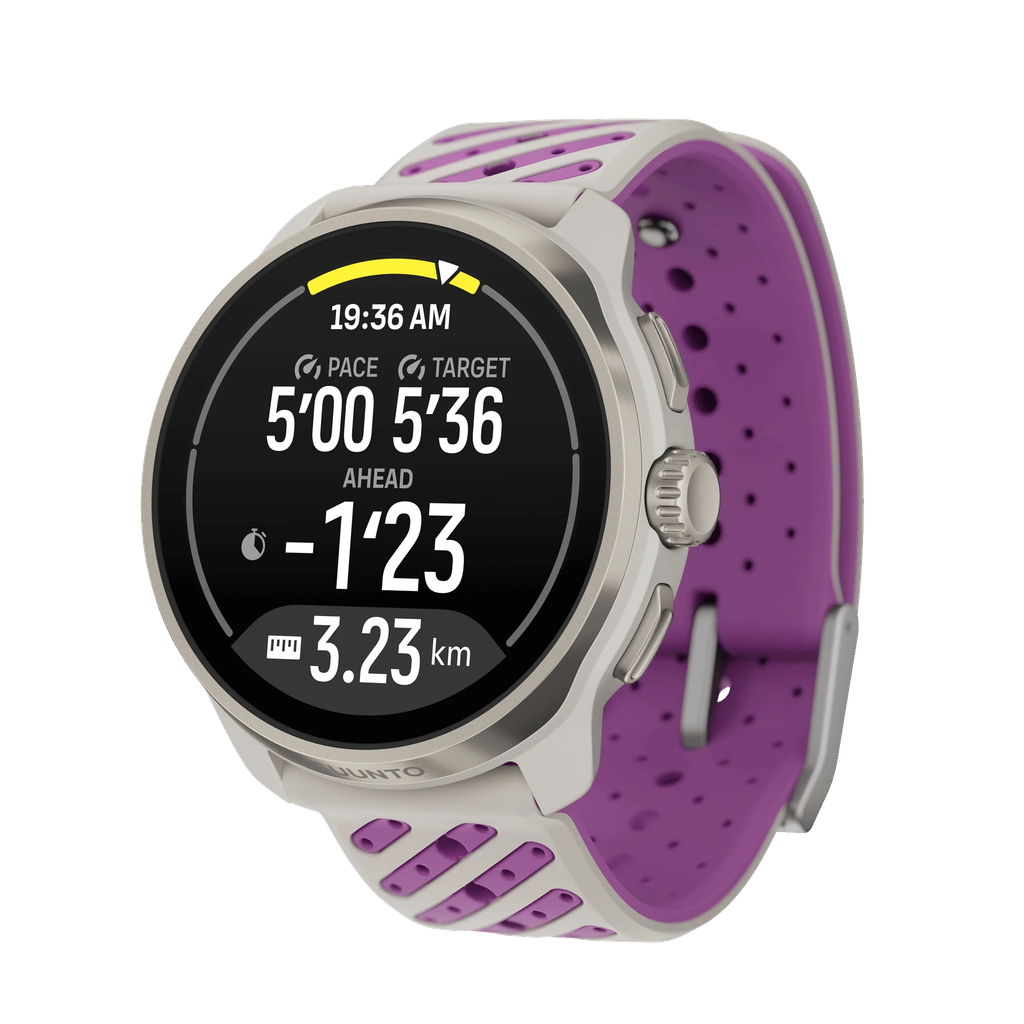
Announced on October 15, 2026, the Race 3S targets runners and outdoor athletes who want premium training tools without wearing a large watch.
Don’t be confused by the name, Suunto decided to Jump from Race S (1) to Race 3s because the next watch in line for launch will be its bigger sister, Race 3. There is a Race 2 bigger watch but no Race 2s.
But how much has actually changed from Race S, and is it worth upgrading? Source: Suunto’s launch announcement.
1. Design and Dimensions
A slightly larger case with tougher glass
The Race 3S measures 46 × 46 × 11.4mm, compared with 45 × 45 × 11.4mm for the original Race S. It grows slightly wider while keeping the same thickness.
Its main design specifications include:
- Weight: 56g with the silicone strap.
- Bezel: Titanium.
- Display protection: Sapphire crystal.
- Strap width: 22mm.
- Water resistance: 5 ATM.
- Colours: Orchid, Feather and Black.
Sapphire replaces the Gorilla Glass used on Race S, providing a more scratch-resistant surface for outdoor use. In terms of weight: the new watch is lighter than the 60g stainless-steel Race S, but slightly heavier than its 53g titanium version.
A much brighter AMOLED display
Screen size and resolution remain 1.32 inches and 466 × 466 pixels, but brightness increases from 600 to 2,000 nits.
That is more than three times the peak brightness, making visibility in strong sunlight a major selling point. The new LTPS Hybrid AMOLED panel also supports a 5–60Hz adaptive refresh rate.
2. New Heart Rate Sensor
The Suunto Race 3S introduces an optical heart-rate module with six LEDs and four photodetectors, replacing the Race S arrangement of four LEDs and two photodetectors.
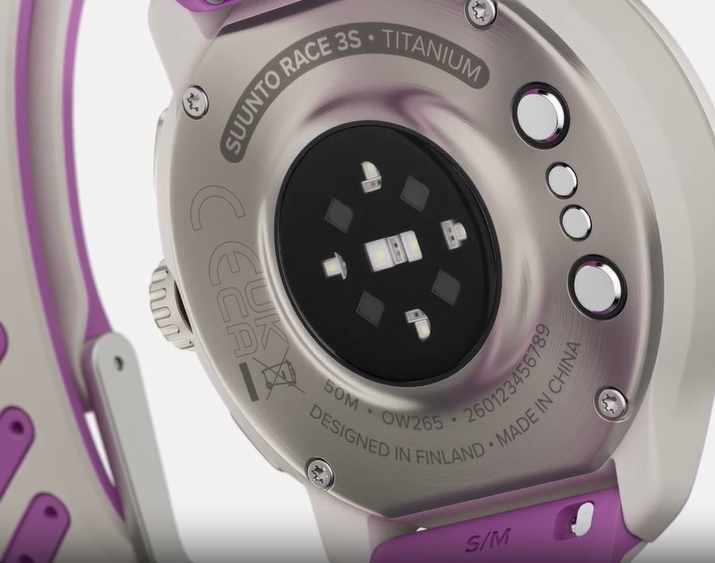
The upgraded hardware sits behind 2.5D curved sensor glass, designed to improve contact with your skin. Suunto also highlights updated algorithms intended to reduce interference from movement and maintain tracking through changing conditions.
For runners, the intended benefit is more consistent wrist-based readings when effort changes. However, the hardware upgrade alone does not establish how accurate it will be across every activity.
Both watches support an external heart-rate belt. On Race 3S, pairing a compatible belt also enables ZoneSense intensity analysis natively instead of Suunto plus app; this capability should not be confused with measurements from the optical sensor alone.
3. Sports Features
Training and navigation
The Race 3S supports 120-plus sport modes, covering running, trail running, cycling, swimming, mountaineering and other activities.
Its core sports toolkit includes:
- Dual-band L1 and L5 satellite positioning.
- Free global offline maps.
- Route navigation and Climb Guidance.
- Training-load, recovery, sleep and HRV insights.
- SuuntoPlus tools for additional activity-specific guidance.
The new Apollo 510 processor replaces the Apollo 4 Plus, with Suunto promising quicker map interactions and menu responses. Storage doubles to 64GB, creating more room for maps, routes and training data.
Several headline features are familiar to Race S owners. Offline maps, dual-band GPS and Climb Guidance already exist on the older model, so their presence alone does not justify upgrading.
AI coaching and features arriving later
The launch also introduces Suunto AI Coach, a conversational assistant in the Suunto app. It can interpret training information, answer questions and help create workouts, routes and personalized plans.
Two announced capabilities require future updates:
- Race Planner: Personalized pacing based on the route, weather and your race goal.
- Offline music playback: Stored music for listening without carrying your phone.
Suunto identifies both as post-launch additions, so buyers should distinguish promised functionality from what is available immediately.
If you are also considering Suunto’s running-focused alternative, read our Suunto Run 2 review.
4. Battery Life
Battery endurance is another meaningful improvement over Race S.
Suunto’s launch figures specify:
- Up to 38 hours: Dual-band GPS recording.
- Up to 32 hours: Dual-band GPS with the always-on display enabled.
- Up to 12 days: Everyday smartwatch use.
The original Race S offers up to 30 hours of dual-band GPS and nine days of smartwatch use. The new model therefore adds up to eight hours of GPS endurance, approximately a 27% increase.
Suunto attributes the newer watch’s endurance partly to a high-density silicon-carbon battery. Actual runtime depends on settings, display use and operating conditions. For long races, the distinction between the 38-hour and 32-hour configurations matters when planning your charging strategy.
5. Suunto Race 3s vs Race S: New Features
| Feature | Suunto Race S | Suunto Race 3S |
|---|---|---|
| Dimensions | 45 × 45 × 11.4mm | 46 × 46 × 11.4mm |
| Weight with strap | 60g steel / 53g titanium | 56g |
| Front glass | Gorilla Glass | Sapphire crystal |
| Peak brightness | 600 nits | 2,000 nits |
| Processor | Apollo 4 Plus | Apollo 510 |
| Optical heart-rate hardware | Four LEDs, two photodetectors | Six LEDs, four photodetectors |
| Storage | 32GB | 64GB |
| Dual-band GPS battery | Up to 30 hours | Up to 38 hours |
| Everyday battery | Up to nine days | Up to 12 days |
| Offline music | Phone music controls | Playback planned through an update |
For existing owners, the strongest upgrade arguments are the display, sapphire protection, sensor hardware and additional battery endurance. Race S remains capable if its current tracking and navigation tools already meet your needs.
6. Suunto Race 3s Price
The Suunto Race 3S costs $599 in the United States and €499 in Europe. European availability begins October 15, while Suunto’s US store lists estimated shipping from October 29, 2026.
Eligible buyers receive three months of Suunto AI Coach when they activate the watch by December 31, 2026. Ongoing coaching costs should be considered separately from the hardware purchase.
The Race 3S offers the clearest value to athletes who regularly train in harsh sunlight, tackle long events or want sapphire protection. For satisfied Race S owners, upgrading depends on how useful those specific improvements will be.