The European Union has introduced a groundbreaking labelling system for smartphones and tablets aimed at stopping short-lived gadgets, misleading battery claims, and products that are difficult or impossible to repair. If you’ve ever bought a phone that barely made it through a day after a year of usage, the EU phone energy label exists precisely to prevent that.
For the first time, phones and tablets are treated like appliances — measured, compared, and regulated for efficiency, lifespan, longevity, and repairability.
This change directly affects buyers, manufacturers, and even online stores displaying device specifications.
In this post, we explain exactly how the EU phone and tablet label works, what every metric on it means, and when compliance became mandatory.
When Did EU Phone and Tablet Labelling Become Mandatory?
EU smartphone and tablet energy labelling became mandatory on 20 June 2025.
From this date onward, it is illegal to sell new smartphones and tablets in the EU without:
- A printed energy label in physical stores
- A digital energy label for online listings
- A full technical product sheet (product fiche)
These rules are enforced under:
- EU Energy Labelling Regulation (EU) 2023/1669
- EU Ecodesign Regulation for smartphones and tablets
This means manufacturers are now legally required to publish standardized performance and longevity data rather than relying on vague marketing claims.
The regulation forces companies to move away from planned obsolescence and build devices that are not just fast — but long-lasting, serviceable, and energy efficient.
Retailers also have a legal obligation to display the label clearly on product pages, meaning consumers can no longer be misled by selective specifications or exaggerated battery performance promises.
What Devices Are Covered Under the Regulation?
The law applies to:
- Smartphones
- Feature phones
- Slate tablets (no physical keyboard)
It excludes:
- Laptops and convertibles
- Foldable and rollable phones (for now)
- Specialized rugged/military devices
This focused scope ensures that mainstream consumer electronics — the devices with the highest turnover rate — are addressed first.
Tablets with removable keyboards are excluded because they fall under laptop classification, which has separate efficiency regulations.
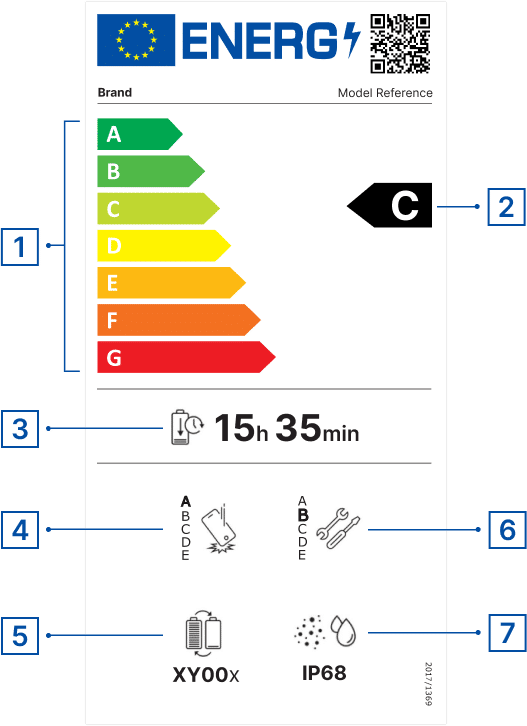
Understanding the EU Phone Energy Label
The label is visually similar to appliance labels but redesigned for electronics. Instead of focusing on power draw alone, it emphasizes:
- Energy efficiency
- Battery longevity
- Physical durability
- Repairability
- Environmental impact
Each metric on the label is independently tested using standardized protocols across all manufacturers.
This ensures that two devices with the same rating truly offer comparable performance — not subjective claims.
Energy Efficiency Rating (A–G Scale)
Every smartphone and tablet receives an efficiency grade from A (best) to G (worst).
What does this rating measure?
It factors in:
- Charging efficiency
- Power usage under load
- Idle drain
- Energy lost as heat
- Battery utilization
Instead of ranking devices purely by wattage, the EU focuses on how well each phone uses the energy it consumes.
Why efficiency matters more than battery size
A large battery does not guarantee good battery life. Energy efficiency determines:
- Heat output
- Throttle behavior
- Long-term stability
- Charging speed sustainability
A smaller battery in a well-optimized phone can outperform a larger battery in an inefficient device.
This is why the energy label favors software and hardware optimization rather than brute force.
Battery Life Per Charge
The second field on the label shows battery endurance in hours and minutes.
What does it include?
Battery testing includes:
- Web browsing
- Video playback
- Call usage
- Idle time
- App loading
- Background processes
Phones are tested under repeatable lab conditions using a defined workload profile.
Why this is better than manufacturer claims
Marketing phrases like:
- “All-day battery”
- “Fast charging”
- “Extreme endurance”
…are subjective and inconsistent.
The EU system replaces guesswork with a fixed benchmark.
If one phone lasts 18 hours and another lasts 26, that difference is now visible upfront.
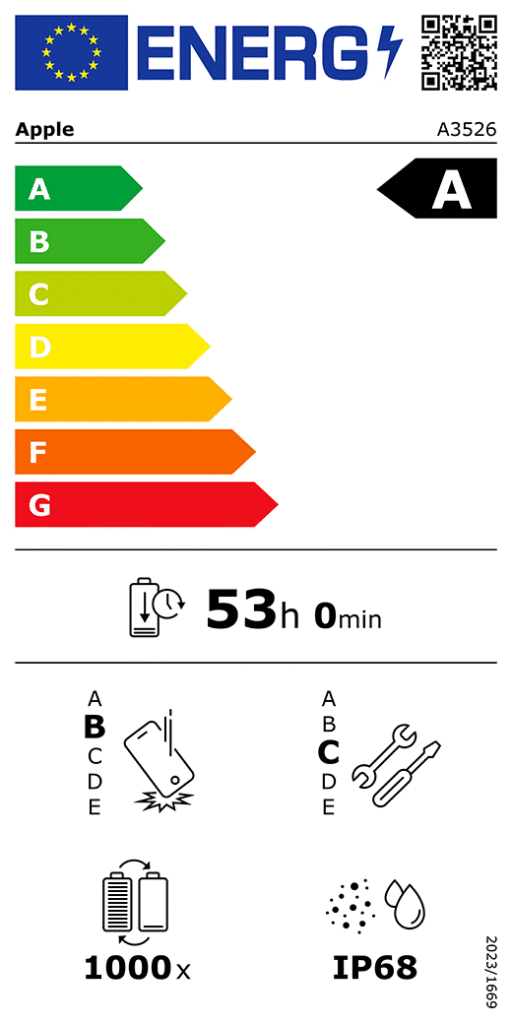
Look at Example of iPhone 17 Pro Max Eu Label below, battery endurance is 53 hours or 1000 cycles.
Battery Cycles — The Most Powerful New Metric
One of the most revolutionary additions to EU labelling is battery cycle disclosure.
What is a battery cycle?
One cycle equals:
- Using 100% of battery capacity — regardless of how many times it was charged
For example:
- Two charges of 50% = one full cycle
- Five charges of 20% = one full cycle
What the EU requires
Manufacturers must now state:
The number of charge cycles until battery health drops to 80%
This exposes battery quality that was previously hidden.
Why this matters
Many phones fail not because the processor is slow —
They fail because the battery degrades too quickly.
A phone with:
- 500 cycles = unreliable after ~1 year
- 1,000 cycles = 2–3 years
- 1,600 cycles = long-term durability
This single metric eliminates cheap battery chemistry from the market.
Repairability Index
The repairability score is ranked from A to E, with A being easiest.
What does it evaluate?
It includes:
- Ease of disassembly
- Availability of replacement parts
- Tool complexity
- Modular component design
- Manuals & diagnostic access
Why this helps consumers
A phone that rates A:
- Can be repaired faster
- Cost less to fix
- Has available spare parts for years
- Reduces full device replacement
The EU also mandates spare parts availability for:
A minimum of 7 years after manufacture
This protects buyers from being forced into upgrades due to missing components.
Durability Rating — Phones Can No Longer Be Fragile by Design
Manufacturers must now rate devices based on physical resilience.
What is evaluated?
Tests include:
- Repeated drop simulation
- Screen cracking thresholds
- Pressure stress
- Button endurance
- Port longevity
Why this matters
Flagships have historically focused on thinness over structure.
With durability scoring:
- Weak frames are punished
- Glass quality is measurable
- Structural defects affect score
Devices with fragile aesthetics now compete at a disadvantage.
Water and Dust Resistance (IP Rating)
The ingress protection (IP) rating is now mandatory on the label.
Example:
- IP67 = water resistant
- IP68 = water-tight and dustproof
This prevents fake waterproof marketing.
If it’s on the label:
- It passed the test
- It’s enforceable by law
EU Label vs Manufacturer Marketing
Previously, companies could exaggerate claims such as:
- “Longest battery life”
- “Optimized efficiency”
- “Eco-friendly”
Now:
- Metrics are regulated
- Ratings are lab-tested
- Claims are verified
This creates a competitive marketplace based on engineering excellence rather than advertising budgets.
Why the EU Label Matters Long-Term
This system is expected to:
- Reduce e-waste
- Extend phone lifespan
- Reduce electricity usage
- Lower repair costs
- Increase transparency
As manufacturers globalize supply chains, many non-EU markets will get EU-compliant models indirectly.
In practice, the EU is setting a global electronics durability standard.
Final Thoughts
The EU phone label is not cosmetic.
It represents:
- The end of disposable phones
- The beginning of accountable manufacturing
Consumers gain verification, manufacturers face pressure and devices last longer.
This is how technology grows up!
About the Author