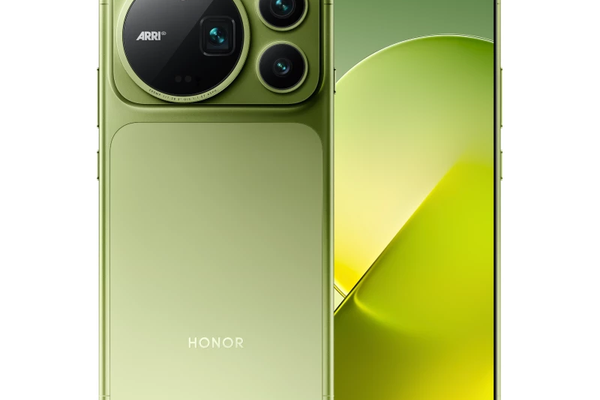
The HONOR 600 Pro vs HONOR 400 Pro comparison shows how the global numbered Pro series changes from 2025 to 2026. The newer model keeps the familiar 200MP main camera, 50MP telephoto and 12GB RAM, but brings a smaller body, a newer Snapdragon processor and a larger battery.
This comparison uses the European versions, with UK storage configurations. The battery capacities are 6,400mAh and 5,300mAh respectively; different capacities in other markets should not be mixed into the same comparison.
Design and Build: Smaller Dimensions and a Metal Frame

HONOR 600 Pro measures 156 × 74.7 × 7.8mm, making it 4.8mm shorter, 1.4mm narrower and 0.3mm thinner than HONOR 400 Pro. The weight also drops from 205g to 195g. These changes make the new phone more compact without reducing its battery capacity.
The frame changes from plastic to metal, while the glass back remains. Both offer IP68 and IP69 dust and water resistance; the 600 Pro additionally carries an IP69K rating. The protection ratings describe tested conditions rather than a guarantee against every type of water damage.
| Feature | HONOR 600 Pro | HONOR 400 Pro |
|---|---|---|
| Dimensions | 156 × 74.7 × 7.8mm | 160.8 × 76.1 × 8.1mm |
| Weight | 195g | 205g |
| Frame | Metal | Plastic |
| Protection | IP68 / IP69 / IP69K | IP68 / IP69 |
Display: A Smaller Screen with a Higher Peak Rating
The 600 Pro has a 6.57-inch AMOLED display, compared with the 400 Pro’s 6.7-inch panel. Resolution changes from 2800 × 1280 to 2728 × 1264, while pixel density remains very close at 458ppi versus 460ppi. The main difference is screen area rather than a meaningful jump in sharpness.
Both support a maximum 120Hz refresh rate, HDR Vivid and 3840Hz PWM dimming. HONOR rates peak HDR brightness at 8,000 nits for the 600 Pro and 5,000 nits for the 400 Pro. These figures apply to specific conditions and should not be interpreted as continuous brightness across the entire screen.
| Feature | HONOR 600 Pro | HONOR 400 Pro |
|---|---|---|
| Display | 6.57-inch AMOLED | 6.7-inch AMOLED |
| Resolution | 2728 × 1264 | 2800 × 1280 |
| Refresh rate | Up to 120Hz | Up to 120Hz |
| Rated HDR peak | 8,000 nits | 5,000 nits |
| PWM dimming | 3840Hz | 3840Hz |
Honor 600 Pro Camera vs Honor 400 Pro
Main and Zoom Cameras
Both phones combine a 200MP main camera with optical stabilisation, a 50MP stabilised telephoto and a 12MP ultrawide. The resolution of each rear camera therefore stays the same. The notable change is telephoto magnification, which increases from 3x optical zoom to 3.5x.
That gives the 600 Pro a slightly tighter native telephoto view for distant subjects and portraits. It does not turn every zoom setting into optical zoom, and the same megapixel count does not mean that image processing or final results are identical.
Front Camera and Video
The main selfie camera remains 50MP. HONOR 400 Pro also has a separate 2MP depth camera at the front. Both generations support 4K recording on the rear and front cameras, so 4K video itself is a retained feature rather than a new capability.
| Feature | HONOR 600 Pro | HONOR 400 Pro |
|---|---|---|
| Main camera | 200MP, OIS | 200MP, OIS |
| Telephoto | 50MP, OIS, 3.5x optical | 50MP, OIS, 3x optical |
| Ultrawide | 12MP | 12MP |
| Main selfie camera | 50MP | 50MP |
| Front / rear video | 4K supported | 4K supported |
Processor: Snapdragon 8 Elite Replaces 8 Gen 3
HONOR 600 Pro uses Snapdragon 8 Elite with Adreno 830 graphics, replacing Snapdragon 8 Gen 3 and Adreno 750. The newer platform uses a 3nm manufacturing process, compared with 4nm on the 400 Pro, and brings Qualcomm’s Oryon CPU design.
Both processors belong to Qualcomm’s high-end Snapdragon 8 family. The 600 Pro advances the processing platform while retaining an eight-core CPU. Performance in individual games and demanding applications still depends on software, cooling and workload, so the chip change should not be reduced to a single assumed speed increase.
| Feature | HONOR 600 Pro | HONOR 400 Pro |
|---|---|---|
| Processor | Snapdragon 8 Elite | Snapdragon 8 Gen 3 |
| Manufacturing process | 3nm | 4nm |
| CPU cores | 8 | 8 |
| Graphics | Adreno 830 | Adreno 750 |
Software and Updates: A Newer Starting Point
HONOR 600 Pro launches with Android 16 and MagicOS 10, while the 400 Pro originally shipped with Android 15 and MagicOS 9. Launch software establishes their starting points; it does not imply that the older phone has received no updates since release.
The 600 Pro has six years of OS and security support. The 400 Pro’s commitment includes six major Android upgrades and six years of security updates. Both therefore offer long support periods, with the newer model beginning its lifecycle a year later.
| Feature | HONOR 600 Pro | HONOR 400 Pro |
|---|---|---|
| Launch Android version | Android 16 | Android 15 |
| Launch interface | MagicOS 10 | MagicOS 9 |
| OS support commitment | 6 years | 6 major upgrades |
| Security support | 6 years | 6 years |
Storage and RAM: The Configuration Stays the Same
Both UK models pair 12GB RAM with 512GB storage. That means the new generation does not increase memory capacity or the amount of space available for applications, photos and videos. Neither has a memory-card slot, so the built-in capacity remains an important fixed part of the configuration.
| Feature | HONOR 600 Pro | HONOR 400 Pro |
|---|---|---|
| RAM | 12GB | 12GB |
| Storage | 512GB | 512GB |
| Memory-card slot | No | No |
Battery and Charging: More Capacity, Lower Wired Rating
The European HONOR 600 Pro has a 6,400mAh battery, compared with 5,300mAh. The increase is 1,100mAh, or approximately 21%, despite the smaller and lighter body. This adds capacity, although it does not by itself establish a particular number of extra hours between charges.
Wired charging moves in the opposite direction, falling from 100W to 80W. Wireless charging remains at 50W. Battery size and charging power have therefore changed in different ways, and a full-charge time cannot be calculated simply from those maximum wattages.
| Feature | HONOR 600 Pro | HONOR 400 Pro |
|---|---|---|
| European battery | 6,400mAh | 5,300mAh |
| Wired charging | 80W | 100W |
| Wireless charging | 50W | 50W |
The Main Generational Changes
HONOR 600 Pro combines a smaller metal-framed body with a larger battery, newer processor and slightly longer optical zoom.
HONOR 400 Pro retains the larger screen and higher wired charging rating. Camera resolutions, UK memory capacity, 120Hz refresh rate and 50W wireless charging remain the principal similarities.